This review contains spoilers.
Deal with it. B-)
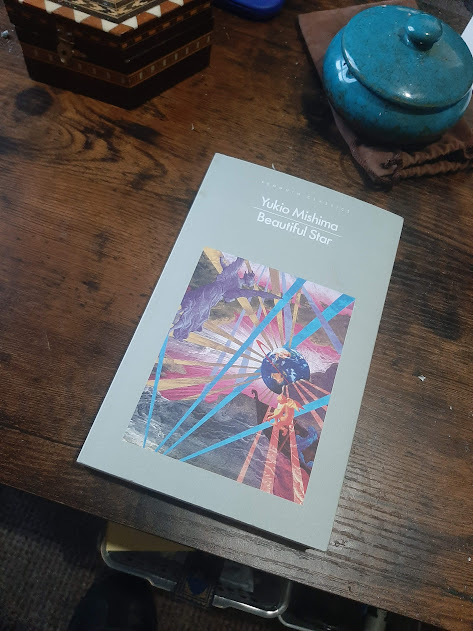
I am sat reading some reviews, here, of Mishima’s Beautiful Star. And I want to say that, although I really enjoyed the book, and would have some things in common, I would have thought, with people who also loved the book, this isn’t totally how it seems now.
One of the good things about this book is that it seems to provoke a strong reaction from some people. Then, that “strong reaction” gets written about. The quality of the writing on people who dislike this book, I found more palatable to my tastes.
Here’s what I reckoned happened when Mishima penned this novel’s story arc. I think he went to give us a happy-go-lucky positive, and humorous story. Maybe he had written about half of this book this way, then got sick at himself for wanting to create such cotton-candy literature.
I’ll tell you roughly what happens in this book in a nutshell, and drop some of my insights and opinions along the way.
The family we meet at the start consisting of Juichiro, Iyoko and their two kids, are elitist and eccentric people. I can relate. Just saying.
Another thing I can relate to here, is the central theme: they saw UFOs. This happened to me, as well when I was 21 so It’s exhilarating to see and hear these type of accounts of these sorts of experiences. This family in particular, took it to be a cue to be so loving and maintain and expand world peace. They interpreted this strange event, in other words, in a naively optimistic way. So did I, when I saw flying saucers. I could relate to the character of Juichiro quite well then. Making my blogs would be a similarly pathetic venture, to do something with the weird event. Because we’re not talking about an abduction, this is purely a visit from the saucers. It is what it is, and it’s so admirable to put and force a positive stance on events of such a nature.
The book is so funny and warm-hearted and quirky throughout half it’s pages. And that is cute. Then, the baddies show up. They also have seen flying saucers, and lo and behold, they take it as a cue to destroy mother earth of all it’s human inhabitants.
The third part of the book, which is a huge, heartfelt debate, is where the novel shines most brightly, but also where the tone takes a very dark and bleak tone, under menacing laughter. The outcome is, the baddies win the argument, and poor Juichiro is so humiliated he develops stomach cancer and dies.
Nice one, Mishima.
THE HIGHLIGHTS:
Early in this books chapters I was making notes on chapters that were quite, sometimes overly fixated on what was to become a myopic “bliss”. The hope that this family were going to become significant enough in their project to save earth, that nothing else mattered. The son, Kazuo, is noted as remarking on his father’s venture as “pathetic”, with the “success an artist would have”. Juichiro himself remains noble throughout. A sense of a Japanese Atticus Finch.
Mishima is a clever devil. A decent simile for this might be that the book is in two halfs, an optimistic, idealistic start and a tragic decline into obliteration. As I have inferred already, it’s almost as if he started to write this book with all good and wholesome intentions for the protagonist family; then, took a break, and on returning to the manuscript, announced to himself how sickened he was at his beautiful creation.
Enter the three bad guys, the leader of whom is a so-described “eternal” assistant Professor at a college. We are told hes overly nervous, unattractive, with perfectly round shiny spectacles. The stereotypical “bad man”. It’s so ridiculous how they turn the tide of this little book into oblivion.
After this group of undesirables spots their flying saucers, they meet up, and meditate. All the while this is going on, we are told of the hard work Juichiro is doing to spread his news, views and methods for a lasting world peace. So while that’s in the background, our 3 culprits who fancy the earth destroyed, go on a mission to find an object that could feasibly accomplish this. One buys nutcrackers (to crush the earth) one buys a cup of sulfuric acid (to dissolve it) and so on. The leader suggests a poem.
I love that response, quite dearly, and the poem he writes is indeed destructively beautiful. Then, on the chapter we read this poem, on the next page, he writes the same poem, re-worded to steal the breath from Juichiro. Silencing and muffling any reply he might make, and contributing to our hero’s demise.
Here are the poems:
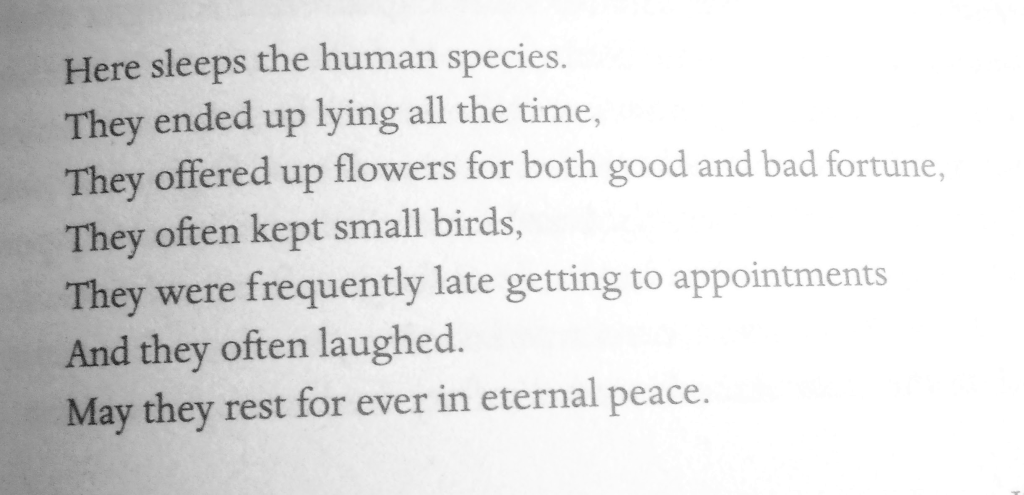
They ended up lying all the time,
They offered up flowers for both good and bad fortune,
They often kept small birds,
They were frequently late getting to appointments And they often laughed.
May they rest for ever in eternal peace.
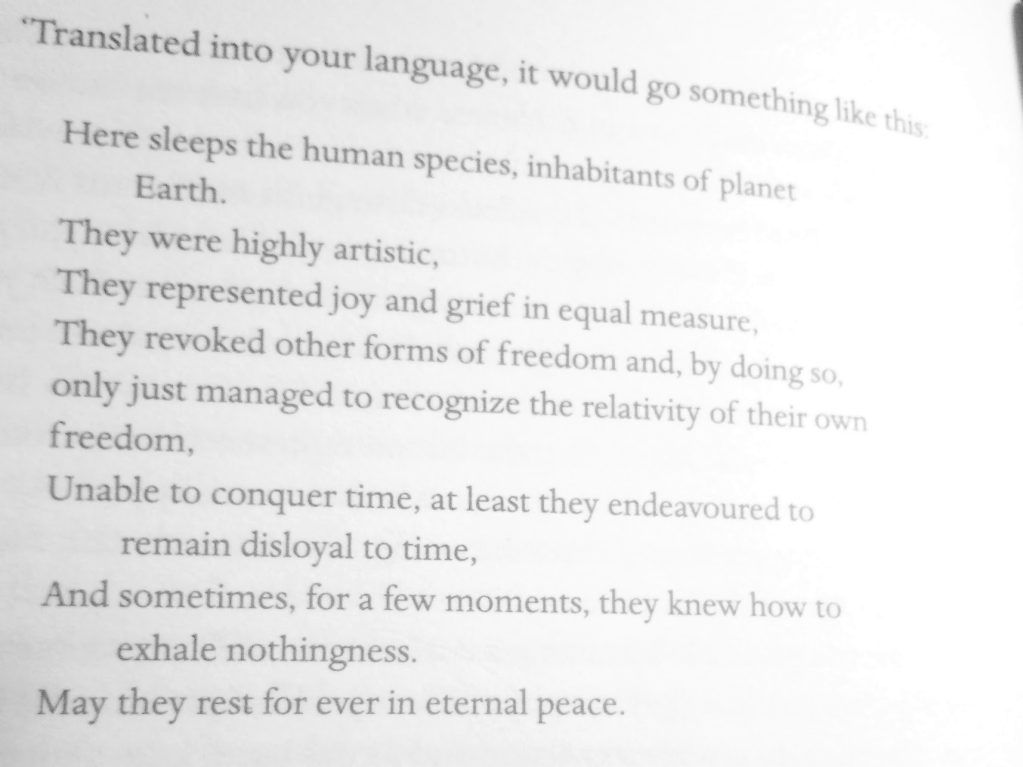
Here sleeps the human species, inhabitants of planet
Earth.
They were highly artistic,
They represented joy and grief in equal measure,
They revoked other forms of freedom and, by doing so, only just managed to recognize the relativity of their own
freedom,
Unable to conquer time, at least they endeavoured to remain disloyal to time,
And sometimes, for a few moments, they knew how to exhale nothingness.
May they rest for ever in eternal peace.
And so, by the end of the novel, us readers are left to pick up the pieces.
And the final paragraph is like Mishima tossing us a piece of candy to console us. I won’t give it all away, but this is the guts of what goes on in this novel.
8/10
 The Humble Rock Dove